

- Published on
6 Shocking Tech Stories: Get the Essential Weekly Roundup
- Authors

- Name
- Christopher Kvamme
- @MidnightBuild12
6 Shocking Tech Stories: Get the Essential Weekly Roundup
Intro
Welcome to this week's tech roundup. This is EmergentWeirdness's first weekly tech news summary. Every week I'll collect the stories that actually matter, skip the fluff, and give you the context you need.
This week brought some genuinely significant developments. A company that's been promising solid-state batteries for years finally started making them. An electric SUV at half the price got positive reviews. AI features moved from demos to shipped products. Similar to what we covered in our AI tools comparison and AI image generator tests, this week showed tech becoming more practical.
Here's what happened.
TLDR
- QuantumScape inaugurated pilot production line for solid-state EV batteries
- Rivian R2 early reviews are positive for the $45,000 EV
- India mandates 3-hour deepfake takedowns, raising questions about implementation
- CLEAR Act would require AI companies to disclose training data sources
- YouTube Music launches AI playlist generator using text descriptions
- Apple Arcade's Oceanhorn 3 brings console-quality gaming to Vision Pro
QuantumScape Finally Starts Making Solid-State Batteries
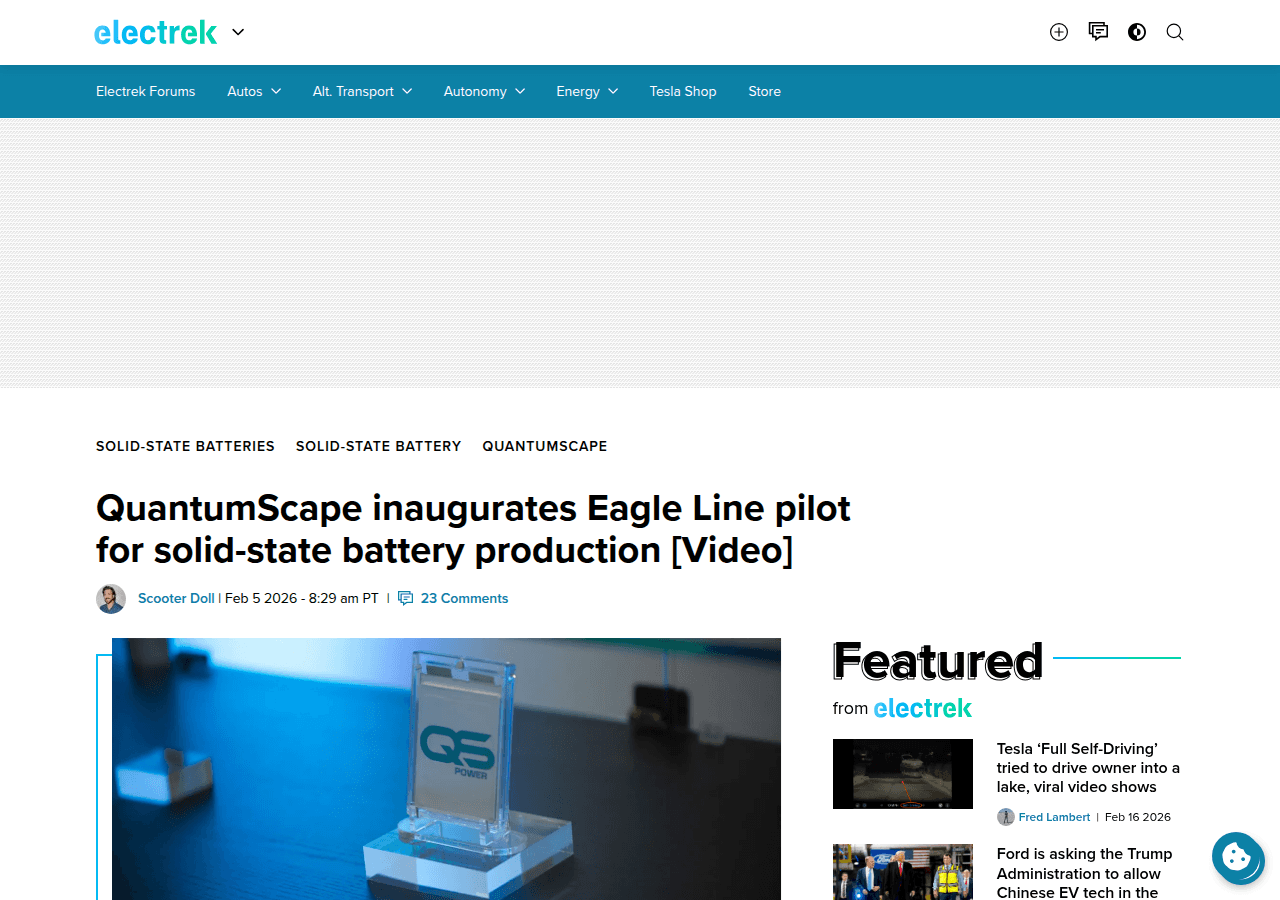
After fifteen years of development, QuantumScape inaugurated their Eagle Line pilot production facility on February 4th. This is the company's first step toward actually manufacturing solid-state batteries at scale.
Solid-state batteries replace the liquid electrolyte in conventional lithium-ion cells with a solid material. The benefits are real: higher energy density, faster charging, longer lifespan, and reduced fire risk. The challenge has been manufacturing them reliably and cheaply.
QuantumScape's anode-free lithium-metal cells are roughly the size and shape of a silvery deck of cards. The company claims they address most shortcomings of current lithium-ion technology. OEM partners including Volkswagen Group attended the inauguration.
The company delayed this moment multiple times. "Now comes the hard part," as InsideEVs put it. Pilot production is not mass production. Scaling from a pilot line to supplying millions of vehicles is where most battery startups have failed.
QuantumScape isn't alone in this race. BYD announced breakthroughs in sulfide solid-state batteries. They're targeting pilot vehicles within two years. Toyota and Idemitsu Kosan are building a new factory to produce solid electrolyte for EV batteries.
The technology is finally moving from labs to production lines. Whether any of these companies can actually deliver at scale remains to be seen.
Rivian R2 First Drives: The $45,000 EV Getting Attention
Rivian's R1S costs 45,000. Early drive reviews suggest they didn't gut the vehicle to hit that price.
Patrick George from InsideEVs drove a near-production R2 prototype. The dual-motor version packs 656 horsepower and 609 lb-ft of torque. It hits 60 mph in 3.6 seconds. The range estimate sits at 300+ miles from an 87.4 kWh battery.
The engineering is interesting. Rivian designed a new platform using half the raw materials and components compared to the R1. Nearly four miles less wiring per vehicle. Less complexity typically means lower manufacturing costs and fewer failure points.
The R2 is roughly the same size as the Tesla Model Y. Rivian is clearly targeting that market segment. The launch edition will cost more than the 50,000 to $55,000 for well-equipped models.
YouTubers who tested it are calling it "Rivian's answer to the Model Y." JerryRigEverything took it off-roading. MKBHD thinks it could change EV adoption rates. We'll see when it actually ships later this year.
India's 3-Hour Deepfake Takedown Rule
India amended its IT Rules to require social media platforms to remove deepfake content within three hours of receiving a takedown order. The rules also mandate labeling of synthetic content and traceability requirements.
Three hours is an aggressive timeline. The Internet Freedom Foundation raised concerns that this compressed window eliminates meaningful human review. They're right. Three hours doesn't leave room for careful decisions about edge cases or potential false positives.
Platforms that fail to comply lose safe harbor protections, meaning they can be held legally liable for content they don't remove quickly enough.
Rohit Kumar from The Quantum Hub called it "a more calibrated approach to regulating AI-generated deepfakes." Whether "calibrated" is the right word for a three-hour mandate is debatable.
The implications extend beyond India. When a market of over a billion internet users sets compliance requirements, global platforms often implement similar systems worldwide rather than maintain separate regional infrastructures. This could shape how platforms handle synthetic content everywhere.
What this means in practice depends on implementation. Aggressive takedown requirements can combat genuinely harmful content. They can also enable censorship of legitimate speech, satire, and political commentary. The details of enforcement will matter more than the headline rule.
CLEAR Act: AI Training Data Disclosure
The US Senate introduced the bipartisan Copyright Labeling and Ethical AI Reporting Act. Senators Adam Schiff and John Curtis want to require written disclosure of copyrighted works used to train AI models.
The bill applies to both new models and currently available systems. Companies couldn't grandfather in existing models trained on questionable data.
This follows a wave of lawsuits against AI companies for alleged copyright infringement. Anthropic recently settled with authors for $1.5 billion. The legal landscape is getting expensive.
Right now, AI companies treat training data like a trade secret. They won't tell you what books, articles, code, or images they used to build their models. The CLEAR Act would change that.
The copyright claims underlying these lawsuits are contested. Whether training an AI on copyrighted material counts as infringement, or whether it's more like a human reading books to learn, is an unsettled legal question. Courts have reached different conclusions. The tech industry argues that training is fair use. Publishers and authors disagree.
Transparency about training data is a separate question from whether training on that data is legal. The CLEAR Act addresses transparency. The underlying copyright question remains unresolved.
The bill has bipartisan support, which suggests decent chances of passage. Expect lobbying from AI companies trying to water down requirements.
YouTube Music Launches AI Playlist Generator
YouTube Music rolled out an AI playlist maker for premium subscribers. You describe what you want using text or voice. The AI creates a custom playlist matching your description.
This isn't new technology. Spotify launched Prompted Playlists in December. But it's another example of AI features becoming standard rather than experimental.
The feature appears in the "New" menu at the bottom-right of the YouTube Music app. You can ask for specific genres, moods, activities, or abstract concepts. "Upbeat indie rock for a road trip" or "atmospheric electronic for late-night coding."
Success depends on prompt specificity. Vague requests produce generic results. Detailed descriptions of mood, energy level, and context work better.
YouTube Music has one of the largest music catalogs available. If the AI can effectively search that catalog based on natural language descriptions, this could be genuinely useful. It's a $6.99/month premium feature.
Apple Arcade's Oceanhorn 3 on Vision Pro
Apple announced that Oceanhorn 3: Legend of the Shadow Sea launches March 5th on Apple Arcade. The game works across iPhone, iPad, Mac, Apple TV, and Vision Pro.
The Oceanhorn series is action-adventure gameplay with exploration, combat, and puzzle-solving. Console-quality 3D graphics. The Vision Pro version is notable because it demonstrates what spatial computing gaming could look like.
The Vision Pro's challenge has been content. The hardware is impressive but costs $3,499. The app ecosystem feels sparse. Every quality game helps build that ecosystem.
Apple Arcade costs $6.99/month and includes over 200 games. Whether Oceanhorn 3 specifically drives Vision Pro adoption is doubtful, but it's a step toward a more complete platform.
What This Week Shows
Two themes stand out.
First, technologies that have been "almost ready" for years are finally reaching production. Solid-state batteries have been promised for a decade. QuantumScape is finally making them, even if only at pilot scale. Whether they can scale remains the question.
Second, AI features are normalizing. YouTube Music's playlist generator isn't a breakthrough. It's a catch-up feature matching what competitors already offer. Users increasingly expect natural language interfaces. The novelty is fading. The utility has to stand on its own.
The Rivian R2 story fits here too. Taking technology from the luxury tier and making it accessible at mainstream prices is how innovation actually changes things. A 100,000 concept car.
Next week will bring more stories. That's how this works.
Frequently Asked Questions
What's a solid-state battery and why does it matter?
A solid-state battery replaces the liquid electrolyte in conventional lithium-ion batteries with a solid material. The potential benefits include higher energy density (longer range), faster charging, longer lifespan, and reduced fire risk since there's no flammable liquid.
The challenge has been manufacturing them reliably at scale. Companies have promised solid-state batteries for years without delivering. QuantumScape's pilot production is a step toward actual products, but mass production remains unproven.
What's a deepfake?
A deepfake is AI-generated synthetic media that makes someone appear to say or do things they never actually did. The technology uses machine learning to swap faces, mimic voices, or create fabricated video.
India's new rules require platforms to remove flagged deepfakes within three hours. This raises practical questions about how platforms can evaluate content that quickly, and whether the speed requirement will lead to over-removal of legitimate content.
Is the Rivian R2 available now?
No, the R2 launches later in 2026. Early drive reviews are based on near-production prototypes. The company hasn't announced exact timing. The $45,000 base price refers to a future configuration. Launch editions will cost more.
How do I use YouTube Music's AI playlists?
You need YouTube Music Premium ($6.99/month). Open the app on iOS or Android, tap the "New" menu at the bottom-right, and look for the AI playlist option. Describe what you want specifically. "Energetic indie rock for a morning workout" works better than "good music."
Conclusion
This was a solid week for concrete progress over promises. QuantumScape moved from talking about solid-state batteries to actually making them. Rivian showed an affordable EV that might actually be good. AI features shipped as standard functionality rather than experimental demos.
The regulatory stories are more complicated. India's deepfake rules and the US CLEAR Act represent governments trying to respond to new technology. Whether those responses are well-designed or will have unintended consequences remains to be seen.
Next week will bring new stories. See you then.
Sources
- QuantumScape inaugurates Eagle Line pilot for solid-state battery production - Electrek
- A California Company Just Kicked Off Solid-State Battery Pilot Production - InsideEVs
- BYD breaks ground with solid-state battery and 10,000-cycle sodium tech - CarNewsChina
- I Drove A Rivian R2 Prototype. It's Going To Surprise People - InsideEVs
- India orders social media platforms to take down deepfakes faster - TechCrunch
- Oceanhorn 3 launches March 5 on Apple Arcade - Apple Newsroom