
- Published on
Motorola Just Made Privacy Phones Normal
- Authors

- Name
- Christopher Kvamme
- @MidnightBuild12
Motorola Just Made Privacy Phones Normal
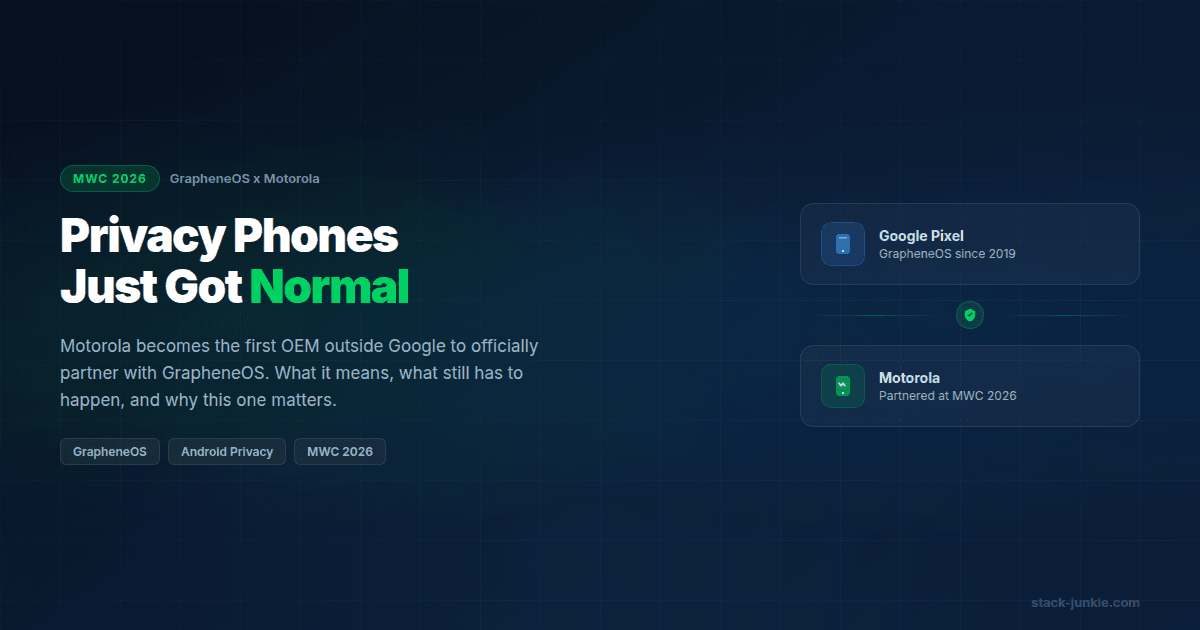
Motorola announced a long-term partnership with the GrapheneOS Foundation at MWC 2026, making Motorola the first OEM outside Google to officially support the privacy-focused Android OS. For years, running GrapheneOS meant owning a Pixel. That is no longer true. The lock is broken, and the market for privacy phones just got a lot bigger.
Here's what actually matters:
- The Motorola-GrapheneOS deal, and what it isn't yet
- What GrapheneOS does for someone who's never flashed a phone
- Why Pixel owned this space for so long
- Motorola's real motive
- What to do if you're thinking about a privacy phone right now
Table of Contents
- What the Motorola x GrapheneOS partnership actually is
- Why GrapheneOS has been Pixel-only since 2019
- What GrapheneOS actually does, for people who don't flash phones
- Why Motorola decided the market is big enough now
- What this means for the Pixel monopoly on privacy phones
- What still has to happen before you can buy one
- FAQ
What the Motorola x GrapheneOS partnership actually is
At MWC 2026 in Barcelona, Motorola announced a "long-term partnership" with the GrapheneOS Foundation, the Canadian nonprofit behind the hardened Android OS. The deal has two parts. First: a future Motorola smartphone will ship with GrapheneOS pre-installed. Second: some GrapheneOS features will come to other Motorola devices over time.
The GrapheneOS Foundation put it plainly in the announcement: "This collaboration marks a significant milestone in expanding the reach of GrapheneOS."
That's the news. Now here's the important caveat, because tech headlines have a habit of outrunning reality.
No specific device has been named. No timeline has been confirmed. And critically, existing Motorola phones do not meet GrapheneOS's hardware requirements. Even the Motorola Signature, Motorola's current flagship, falls short. A new device will need to be purpose-built to qualify.
This isn't a product launch. It's a stated plan to build toward one. That distinction matters if you're hoping to buy a Motorola privacy phone this spring.
Still: the commitment itself is news. GrapheneOS has been Pixel-only since it launched in April 2019. An OEM partnership of any kind is genuinely unprecedented for this project.
Why GrapheneOS has been Pixel-only since 2019
GrapheneOS's Pixel exclusivity wasn't snobbery. It was a hardware problem.
The project's FAQ lays it out directly: GrapheneOS requires devices with a re-lockable bootloader, proper hardware attestation support, and a strong hardware security element. These aren't preferences. They're the technical prerequisites for the security model to work at all. Without a re-lockable bootloader, for example, anyone who stole your phone and connected it to a computer could compromise the OS without your knowledge. GrapheneOS's threat model assumes adversaries with physical access. The hardware has to hold that line.
Pixel phones, particularly from the Pixel 6 onward with Google's Titan M2 security chip, meet those requirements. Most other Android phones don't, partly because phone makers haven't had a reason to invest in the architecture until now.
In October 2025, GrapheneOS quietly confirmed it had been working with a "major Android OEM" since June 2025 to enable official support for future devices. The partnership would target flagship Snapdragon hardware, not Google's Tensor. That unnamed OEM turned out to be Motorola. The announcement in Barcelona was the official close of a deal that had been months in the making.
GrapheneOS had also been openly critical of Google's patch timelines, arguing that vulnerabilities sat unpatched for too long while waiting on the standard Android update pipeline. Working directly with a hardware partner gives the project more control over when security fixes land. That's not a trivial point.
What GrapheneOS actually does, for people who don't flash phones
Here's the version that skips the jargon.
GrapheneOS is Android. It runs Android apps. It looks like Android. You use it the same way. The differences are in what the OS does in the background, by default, without you configuring anything.
Most Android phones come with Google's services baked into the system at a privileged level. Google Play Services runs with deep access to things like location, contacts, and device identifiers. GrapheneOS removes that. Google services are not present by default. If you want them, you can install a sandboxed version of Google Play that runs as a normal app with no special privileges. This is called Sandboxed Google Play, and it means your banking app and Spotify work, while Google's tracking access is reduced to what you'd expect from any regular app.
Beyond that, GrapheneOS adds defenses that stock Android doesn't have:
- Stronger app isolation: apps can't read each other's memory or interfere with system processes as easily.
- Per-app network and sensor controls: you can block individual apps from accessing the internet, microphone, camera, or sensors entirely, not just prompt for permission.
- Zero-day exploit protections: the project runs a hardened memory allocator and disables attack surface that most users don't need, reducing the pool of vulnerabilities that can be exploited.
- Verified boot with re-locking: after installation, you can re-lock the bootloader. The hardware then verifies the OS on every boot. If anything has been tampered with, the device alerts you.
The practical reality is that most GrapheneOS users' day-to-day experience looks a lot like a normal Android phone. They install apps through the Play Store (via the sandboxed layer), they use Signal and WhatsApp and their bank's app, they get updates automatically. The difference is what those apps can reach.

Why Motorola decided the market is big enough now
Privacy as a product category has been growing for years. But it has mostly grown in a specific demographic: journalists, activists, security researchers, and the technologically paranoid. The mass market has stayed on stock Android and iOS, not because people don't care about privacy but because they care more about convenience.
The Hacker News discussion on this announcement hit 1,990 points and 718 comments within hours of going live. That makes it one of the biggest stories on the platform in recent memory. The reaction was not just enthusiasm from the usual GrapheneOS crowd. It was from people who have thought about making the switch but couldn't justify a Pixel, people whose employers are asking hard questions about mobile device security, and people who have watched enough data scandals to want a phone that defaults to "no" instead of "yes."
Motorola's pitch to itself almost certainly wasn't purely privacy altruism. The announcement was framed as a B2B play alongside ThinkShield, Lenovo's enterprise security brand. Moto Analytics (fleet management for IT teams) and Private Image Data (automatic metadata stripping from photos) launched the same day. The enterprise angle is clear: companies managing device fleets want verifiable security, and GrapheneOS is about as verifiable as Android gets.
But the consumer angle is real too. Android is a commodity. Samsung, Google, OnePlus, and a dozen other OEMs make great hardware that runs more or less the same software. Motorola doesn't win that race on specs. It can win on trust if it builds the right device at the right price, in a market where people are increasingly skeptical of what their phones are doing when they're not looking.
What this means for the Pixel monopoly on privacy phones
There has always been something structurally odd about the privacy-phone ecosystem. The OS with the best privacy track record ran exclusively on hardware made by the company whose entire business model is built on knowing as much about you as possible. Pixel phones are good phones, and Google has invested seriously in their security architecture. But the default position of privacy-focused Android users has been to buy Google hardware just to run an OS that avoids Google software.
That's not going away. GrapheneOS will continue to support Pixel phones. The Pixel 6 through Pixel 10 series remain fully supported, and Pixel 10 support is confirmed. Pixel phones will remain the practical choice for anyone who wants to run GrapheneOS today.
What changes is the structure of the market. Choice now exists. Or will exist, once a device ships.
This matters more than it might sound. Monopoly, even an accidental one, creates lock-in. Pixel devices are not sold in every market. They are not always competitively priced. Some carriers block bootloader unlocking. A Motorola option, priced and distributed differently, could bring GrapheneOS to users who couldn't realistically access it before. The partnership targets flagship Snapdragon hardware, which is distributed globally as part of Motorola's standard lineup.
Whether Motorola can actually execute on a device that meets GrapheneOS's requirements is a different question. The track record of announced partnerships in the Android world producing actual products is mixed. But the intent is on the table, officially, with both parties' names on it.
What still has to happen before you can buy one
A direct answer: a lot.
Existing Motorola devices don't qualify. A new device needs to be engineered with GrapheneOS's specifications from the start. That means hardware choices, firmware decisions, and bootloader design that most OEMs have never had to prioritize. Motorola has to build that phone, get it certified, and get it to market.
There is also the usability question. The Hacker News discussion flagged it directly: GrapheneOS in its current form is not casual consumer territory. The web-based installation process on a Pixel is manageable for someone patient and technically inclined. But "technically inclined" excludes most of the market. A pre-installed version on a Motorola device removes the installation barrier, but someone still has to explain to a first-time buyer what sandboxed Google Play means, why their phone doesn't come with Google Maps already installed, and what to do when an app doesn't work.
Motorola's consumer and enterprise experience could help here, if they apply it. Building sensible defaults that don't compromise the OS's integrity is harder than it sounds.
While you wait, there are some things you can do now. GrapheneOS has a full supported device list at grapheneos.org. If you own a compatible Pixel, installation is documented step by step on the same site. For non-technical users, some vendors sell Pixel phones with GrapheneOS pre-installed through the project's community-linked vendors.
And Motorola has already shipped one small thing. Private Image Data, which strips location and device metadata from photos automatically, is rolling out now to select Motorola Signature devices. It's not GrapheneOS. But it's a glimpse of what Motorola is building toward: a device that defaults to protecting your data instead of sharing it.
FAQ
What phones support GrapheneOS in 2026?
GrapheneOS officially supports Google Pixel devices from the Pixel 6 through Pixel 10 series. This includes the Pixel Fold and Pixel Tablet. No Motorola device is supported yet. The Motorola partnership is aimed at a future device, not existing hardware.
Can I use regular Android apps on GrapheneOS?
Yes. GrapheneOS includes an optional sandboxed Google Play layer, which lets you install and run apps from the Google Play Store. These apps run with no special system privileges. Most common apps, including streaming, banking, and messaging apps, work through it.
Is GrapheneOS hard to install?
On a Pixel, the installation uses a web-based installer and takes an hour or less for someone comfortable with tech. It's not designed for first-time phone flashers, but it's not a command-line operation either. The Motorola pre-installed version would remove this step entirely.
Will Pixel phones stop being supported after the Motorola partnership?
No. GrapheneOS will continue to support Pixel devices through their end-of-life dates. Pixel 10 support is confirmed. The Motorola partnership is an addition, not a replacement.
When will a Motorola GrapheneOS phone be available?
Motorola has not announced a specific device, timeline, or price. This is a partnership announcement, not a product launch. The device needs to be purpose-built.
Related Resources
- GrapheneOS official FAQ and supported devices
- Motorola MWC 2026 press release
- Android Authority coverage of the partnership
Evidence and Methodology
This article is based on Motorola's official MWC 2026 press release, coverage from Android Authority and 9to5Google, the GrapheneOS official FAQ and features documentation, an Android Authority deep-dive from October 2025 on the unnamed OEM announcement, and direct observation of the Hacker News discussion thread (1,990 points, 718 comments, March 2, 2026).
Changelog
| Date | Change |
|---|---|
| 2026-03-02 | Initial publication |